In 1983, Norfolk naturalist Roy Baker, published an article in the Transactions of the Norfolk & Norwich Naturalists Society which talked on the the white-clawed crayfish (Austropotambius pallipes) in Norfolk. For the River Glaven it was said that “Crayfish have been recorded from the Glaven for over a century, but in the present time they are uncommon”. Roy also pointed to an abundance of white-clawed crayfish in otter spraints at Cley during surveys in 1969-1970, but with only two crayfish found in spraints between 1973-1974.
As a ‘young un’ in the early 1980s, my school holidays centred on the Glaven and I would bike to the river (from Bodham) to catch brown trout throughout the valley, but especially between Hunworth and Bayfield. Nowhere was safe from me. The Sayer bike would be stashed in hedges and my fishing rod was taken to some of the most remote of spots, but also to mill pools and gardens – anywhere where I could find deep water and undercut banks where the big fish were. I once fished from a river-side lawn next to a summerhouse and a still steaming cup of tea. I caught an efficient fish.
When the trout were not biting on my worm on sunny afternoons, my attention was diverted to the Glaven’s other fish. With a landing net dipped under the bank and beneath the weed, I caught hundreds of preciously marked bullhead and stone loach and I saw mass gatherings of spawning brook lamprey and hoards of stickleback that are not present in such numbers today. Each time I came across something new, I had to go back to my natural history books – I felt like I was discovered things, but most certainly I was cementing a love of the river that will last forever.
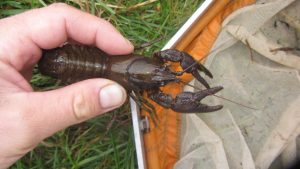
One day, I saw an enormous crayfish in a stony section at Little Thornage that was making its way upstream. I was astonished by this and I can still see this animal crawling along in my mind’s eye. If crayfish had been common in the early 1980s, I would have seen them, so in agreement with the otters, I would say that they were very rare at this time.
What happened to the Glaven’s white-clawed crayfish in the 1970s-80s then? My theory is that pollution hit the river and with “whitefoots” (an old Norfolk name) being highly sensitive to this, they no doubt took a hit, as they probably also did in the neighbouring River Stiffkey. A possible further negative influence would have been river dredging; we will never know.
The next page in the story was written in 2006 when, following a bankside white-clawed crayfish find by the RGCG’s Tony Leech, the brilliant Martin Pugh of Essex Wildlife Trust was commissioned to survey the Glaven for crayfish. Martin got himself installed in a caravan on the Bayfield estate and lost himself in the river valley for the best part of the summer. He even developed a new way of finding crayfish, involving careful, but scarily blind finger tip searches of undercuts and burrows. With such an approach the claws of the crayfish find you as opposed to it being the other way around!
To the joy of RGCG members, Martin found white-clawed crayfish in good numbers throughout much of the middle river and ever since this time we have been watching the population thrive and probably expand. Each October, as part of a term one fieldcourse, our UCL MSc Aquatic Conservation and MSc Conservation students undertake a crayfish study of a river section at Little Thornage and this now acts as a way of monitoring how the species is doing.
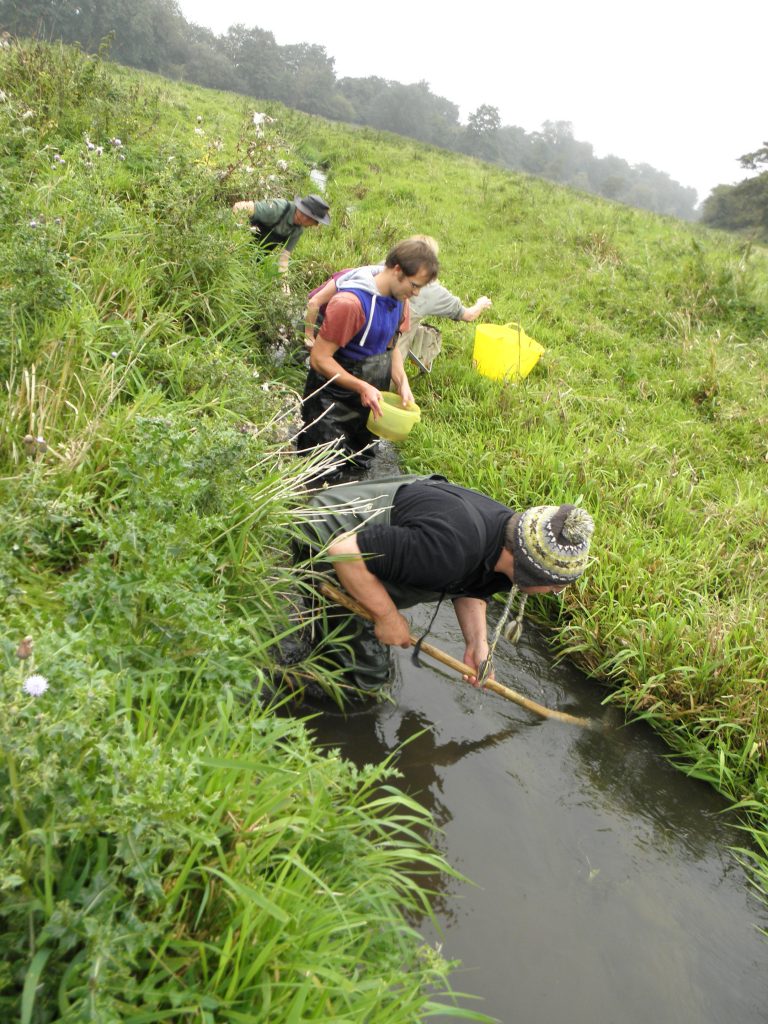
Presently, the Glaven’s white-clawed crayfish population, which was clearly on a knife-edge a few decades back, is now the most important site for the species in south-east England. All the more reason to protect our precious river.
Carl Sayer